Thursday, November 28, 2013

Happy (white) Thanksgiving, America! This is a tough day to be abroad, but I'm thankful for my supportive family and for the fact that I have the opportunity to travel and experience another culture. I do miss a good Thanksgiving dinner, though!

Today is, of course, a work day here in Russia, but we Americans will have our celebration on Saturday. We're making a Thanksgiving dinner for ourseleves and the Russian staff of the American Home. This is a tradition that goes back to the start of the AH 22 years ago, but this year's celebration is a bit more complicated because our old Whirlpool oven (imported from America 22 years ago) is on the fritz, so we're making do and doing our baking and turkey roasting at people's apartments. That means we'll have to lug 25 pounds of cooked turkey on the bus--boy, we'll sure be popular people.

I hear the US is having a wintry Thanksgiving, and, as it turns our, we are too. Today we had our first real snowstorm. Here's a view of my neighborhood. In counting my blessings, I'm can say that I'm thankful that I grew up in a beautiful neighborhood of architecturally distinct single-family houses sorrounding a picturesque lake.


Saturday, November 23, 2013

Snow! We finally had our first appreciable amount of snow here in Vladimir last Thursday. The snow melted within a few hours, but I snapped this picture on the way to the gym in the morning. You get a nice view of scary garage land and an industrial area off in the distance. The weather forecast is calling for warmer temperatures (upper 30s F) for the next week, so who knows when we'll see snow again. That's making everyone here nervous--usually there is snow on the ground by this time, and Russians love snow.


Wednesday, November 20, 2013

Here's a song from the Russian punk rock group Sektor Gaza that I heard today on the bus ride to work. The video is a compilation of scenes from the Russian movie 9 Rota, which is about the Soviet war in Afghanistan. Enjoy.  


Tuesday, November 19, 2013

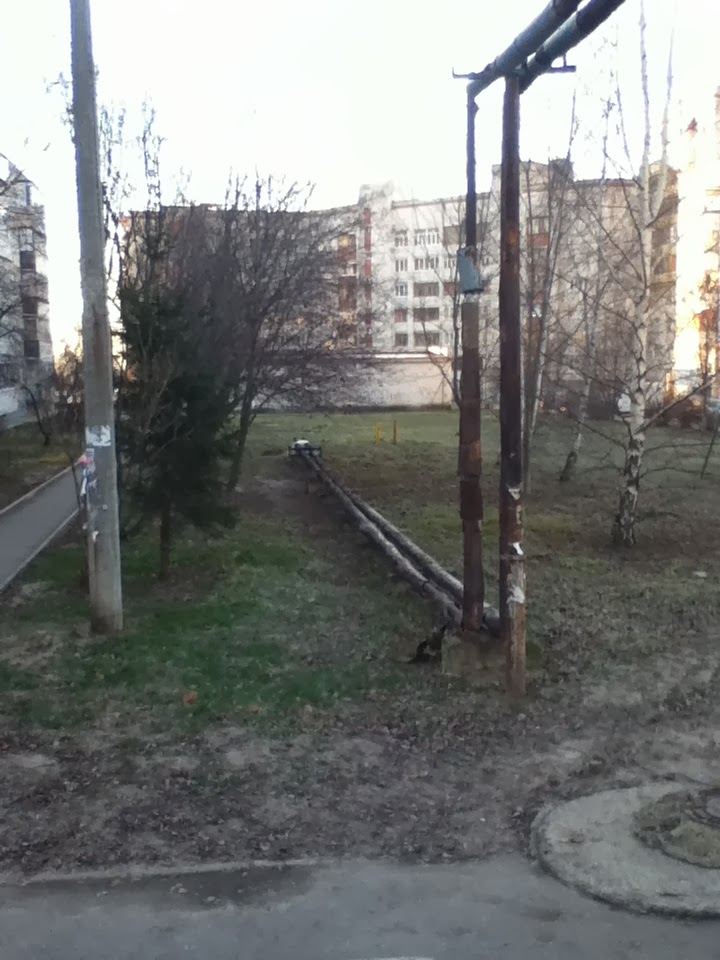
Here's a picture I snapped on the way to the gym this morning. Okay so maybe it wouldn't win any photography awards, but it shows a pair of heat pipes snaking through the courtyard. This is a really common site in Russia, but it was one of the things that surprised me the most when I first came. Heat pipes--ranging from big, city-wide distribution lines to little feeders serving individual buildings--usually run above ground here in Russia.

Well I should back up. Why are there heat pipes snaking around the city in the first place? These pipes are part of a district heat system that serves the whole city. Soviet urban planning was all about centralization and standardization, and so it is fitting that heat is generated in one central plant to distributed around the city. In Moscow, 96% of buildings are connected to the central heat system, and I'm sure the figure is similar here in Vladimir. These systems exist in American downtowns and on college campuses, but America's spread-out pattern of development and strong concept of private property ownership preclude the development of district heat systems on a large scale in the US.

It's not surprising that these pipes look a little on the shoddy side. Russia also faces serious infrastructure problems. How do you maintain infrastructure that is rapidly approaching the end of its design life? How do you privatize a pattern of land use and service delivery that was designed not to be private? How do you oversee utility companies operating in an environment of serious corruption and cronyism? Russia's infrastructure--and city utility systems in particular--is a playground for corrupt businessmen: They defer system maintenance, raise rates, and use cheap materials, and then they export the money to foreign bank accounts and bribe government officials to look the other way. The result?  Utility system breakdowns are common, and it's always a last-minute scramble in October to patch up the last holes in the heat system before the winter. Russians really dislike utility companies and see them as a bunch of money-grubbing crooks, which might not be too far from the truth, at least as far as the top management is concerned. While all those managers are relaxing in Thailand with money kept safely away in their Cypriot bank accounts, regular Russians are stuck with crumbling infrastructure. 

Monday, November 18, 2013

So most bus stops in Russia don't look like those old Soviet ones. One feature most modern bus stops have in common, though, is the little convenience store that is usually located right at the stop. These stores are nothing fancy. They are little huts, usually painted blue and white. The stores display their wares behind glass, and you poke your head into a little window and talk to the blase lady to make your order. On cold days, you have to knock on the iced-laced glass to get her to open the window.  

These shops sell the basics: gum, magazines, cigarettes, and drinks. Now these shops only sell non-alcoholic drinks; a few years ago, you could buy beer at the bus stop, and, although it was technically illegal, no one cared, so you could drink your beer while you waited for the bus. Needless to say, that really fostered Russia's famously tragic love affair with alcohol. You can also buy some strange things at these shops. They often have toys, stuffed animals, laundry detergent, and dish soap for sale. I've even see men's undershirts for sale, which is a surprisingly practical idea--how many guys are inclined to make a special trip somewhere to get an undershirt? American convenience stores have these little stands beat in terms of odd line ups of items (the neighborhood mini mart--where the bleach is right next to the rotisserie chicken, just down from the diapers, catty-corner from the transmission fluid, and across from the PBR), but they fall into the same niche. 

Here's a typical store in a typical Russian neighborhood: 


Sunday, November 17, 2013

Every planner is familiar with the term transit waiting environment. It is a fancy name for a bus stop or a train station, and waiting environments are considered to have an effect on the popularity of public transit as a transportation option. A well lit, clean bus stop makes transit users feel a lot more comfortable than a dingy, dark one. Waiting environment upgrades are a part of any streetscape plan these days in America, and there are some really cool designs for bus stops and train stations out there. And why not make a bus stop--something that is too often left as a grimy afterthought--into a showpiece?

That attitude doesn't exist in Russia. In a country where a huge percentage of the population uses transit every day, bus stops are often ugly, unsheltered, unlit spaces that are the opposite of inviting. Some of the bus stops around my neighborhood are really shocking: an L-shaped structure made of bare concrete and covered in graffiti. Add some potholed pavement and a rusty trashcan and you have yourself a bus stop.

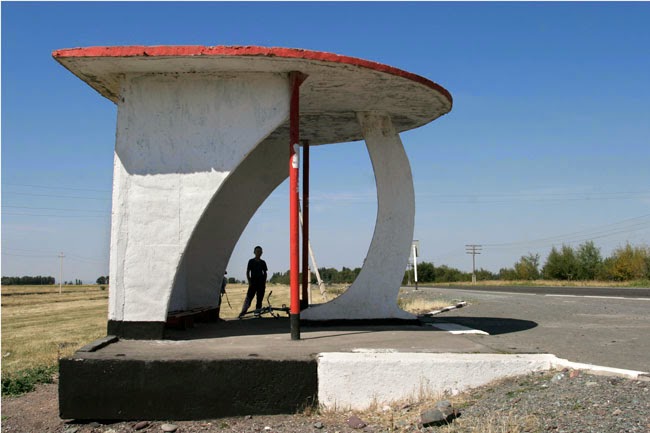
There are some interesting bus stops, however, left over from the Soviet Union. These stops are usually out in the country or in little towns, and they feature unique designs and strange murals. Mostly they are in bad condition nowadays, but they harken back to a time of collective labor, futuristic design, and optimistic imagery. Some of them are actually quite cool in a Soviet-kitsch way. Here are some Soviet bus stops from around the former USSR.


Wednesday, November 13, 2013

I'm an urban planner at heart and by training, and, although I'm noting working in urban planning right now, I know that's where my path leads. I do my best to stay connected to the planning world (I never miss the Atlantic's Cities Blog), and I'm starting to plan my next career move--maybe grad school, maybe an entry-level job. But while I'm here, I love to notice the unique facets of the Russian urban experience.

Russia doesn't lead the world in planning innovations, and its cities are embracing many of the same bad concepts in planning that still plague American cities (car-centric design, big-box sprawl, highway-driven development). But Russian cities are very different from American cities. Russian cities very much bear the influence of socialist urban planning, and that means that they are dense.

Dense cities are great for public transportation because there is a high enough passenger volume to make bus, trolleybus, tram, or even subway services economical. Vladimir has about 350,000 people, but its public transportation system makes the system in Columbus, Ohio--a city more than twice the size--look comical. During off-peak hours, you have to wait for at least 15 minutes for a bus on Columbus's main street. I rarely wait more than five minutes for a bus here in Vladimir, even when I'm leaving work at 9:30pm.

A lot is being written right now about young people in America forgoing cars and moving to cities, and it's interesting to think how this trend will influence American culture and the American lifestyle. But still, there aren't many American twenty-somethings who would move to a small city and try to go carless for two years--it still isn't a reasonable choice in America. Going carless in Peoria, Illinois, for example, is something you do out of necessity, not because you want to. On the contrary, having a car here in Vladimir might actually make my life more complicated. It might shave ten minutes off my commute, but finding parking is next to impossible, gas is very expensive (the same price as in America, and my salary is half of a meager American salary), and any car that I could afford (only a used Lada) would be far more trouble than it's worth (Russians joke that when you buy a Lada, the dealership throws in a bus pass with the deal).

So, while sometimes I grumble about the bus commute and I definitely miss driving, I am proud to say that I've made it more than a year without a car, and it wasn't even very difficult. Now how's that for hipster credibility?